Southpaw launch–a new literary journal


SOUTHPAW # 1

You are invited to the launch of a new literary journal
Southpaw: writing from the global south

To be launched by
Professor Stephen Knight
Wednesday 14th December
Arena Project Space
2 Kerr Street Fitzroy
6.30 pm

Refreshments

All welcome

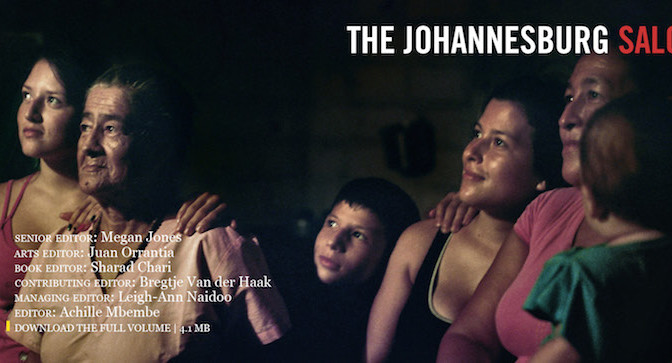
Southpaw # 1 features writing from and about Australia, Africa, China, Philippines, South America and the Pacific around the theme of displacement. It includes essays on the idea of South, power shifts in East Arnhem Land, change and development in Philippines, UFOS in South America and displacement in Colombia fiction and creative non-fiction from Angola, Australia, China, New Zealand, South Africa and Suriname; reviews of Tamil pulp fiction, Indigenous graphic novels and documentaries from the Pacific. There’s an Ainu fable re-told, a radio play and poetry from many places in the global South, much of it in new translation.

Further information: 9416 0232 or 0418 304 500.

Art history in the South–it’s time to step out of the quotation marks

A moment of solidarity between Helena Chávez Mac Gregor (Mexico), José Llano Loyola and Paulina Varas Alarcón (Chile) and Mwape J. Mumbe (Zambia)

A moment of solidarity between Helena Chávez Mac Gregor (Mexico), José Llano Loyola and Paulina Varas Alarcón (Chile) and Mwape J. Mumbe (Zambia)

The symposium Mobility, Circulation, Transnationalism: Art History and the Global South concerned the question of art history as it is practiced in the Global South. It was organised by SAVAH (South African Visual Arts Historians) under the aegis of CIHA (Comité International d’Histoire de l’Art) as an opportunity for the Western-oriented discipline to embrace the experience of those in the South. It sought particularly to acknowledge the discrepancy of resources and in doing so fulfil the key aim ‘to bring to the centre that which, throughout history and across nations, has been traditionally ignored, marginalised, displaced and appropriated.’

It was a bold and ambitious move from SAVAH, which attracted academics from across the world, particularly the Americas, Australasia, Europe and other countries of Africa.

The conference began with the CIHA board giving papers about the importance of South in the discipline of art history. This was followed by papers that reflected various corners of the South. Through an analysis of Rorke’s Drift, Elizabeth Rankin identified social critique as a key element in South African modernism. Robyn Sloggett spoke about the Leonard Adam collection in Melbourne and argued that his category of ‘primitive art’ was liberating at the time. Jonathan Mane Wheoki constructed at Whakapapa (genealogy) of Maori modernism which offered an alternative methodology for art history (hopefully one day applied to art outside New Zealand as well).

After this initial positive statement of southness, the panel sessions that followed were dominated by a critique of northern dominance. The main argument was that the major centres of collecting and criticism in the North take a superficial view of the South, which reflects more their own interests than the real experience of artists and audiences from the periphery. This resentment never really had the opportunity to engage with the CIHA position, which served to only confirm its perceived marginality.

While cathartic, this resentment distracted attention away from the key question: How might the methodologies of art history in the South might evolve parallel to those in the North? In South Africa and other countries of the South, the subjects of non-Western influence are not tribes or villages in distant lands, but peoples who co-exist with academics inside robust democratic cultures. From this perspective, the Northern practice of art history can seem rather forensic. It scrutinises the object for signs of lost meaning – precise, but sterile. By contrast, in the South there is the opportunity to engage with artists in a broader conversation that shares the origins of their work.

The contributions to the panel that I organised, ‘Where to put the baskets in an art gallery?’ demonstrated this broader engagement. The panel was prompted by the experience of visiting to the Johannesburg Art Gallery and finding a sharp division between the craft of black rural women in the shop and the works from urban, mostly white, artists in the gallery. How is this still possible in the ‘new’ South Africa?

Though publications like the Journal of Modern Craft are building up a substantial body of scholarship, craft is still perceived as a quite minor element in art history. Yet as an ‘excluded’ art form practiced by communities across the South, it offered the opportunity to make a critical contribution.

Rather than focussing on the objects as such, the papers reflected on the process of craft production. John Steel presented a story of the Eastern Cape potter Alice Gqa Nongebeza, who wood-fires her pots adapting traditional methods to her own distinct personal style. ‘Mastooana Sekokotoana from Lesotho spoke about the Marija museum and associated arts and crafts festival, concluding the need for a ‘living treasure’ program to recognise masters of traditional skills. Though not specifically about craft, Pam Zeplin’s analysis of the South Project pointed to the engaging way its southern events brought together artists and craftspersons through workshops and performances.[1] This was art not as the history of dead objects, but as a living entity with whom one must engage.

In present circumstances, it seems that the southern perspective on art history offers something quite important to the global discipline of art history. There is a sense of declining interest in art history in universities. For good or for ill, the specialist appreciation of art is at odds with the kinds of democratic energies which seek to open up closed fields of knowledge. We see this most dramatically with the breaching of the diplomatic core by Wikileaks. But parallel challenges have appeared in a wide variety of media, including bloggers who challenge the profession of journalism and YouTube performers becoming celebrities. How can art history respond to this energy without losing the invaluable legacy of specialist knowledge, techniques and taste that it has developed over centuries?

One possibility is to engage in a process of consultation with the broader field of art practice. This would involve conversations with the subjects of art history about their own interest in what the field produces. Boaventura de Sousa Santos talks about an ‘ecology of knowledge’ as constitutive of a southern epistemology. There are developments in anthropology such as the Fijian Vanua Framework for Research discussed by Unaisi Nabobo-Baba that identifies protocols for gaining traditional knowledge. Such knowledge is seen as more than a mirror to the world, but a practice with real world implications. The importance of this locally is reflected in the criticism by black South African curator Khwezi Gule of the work by Bitterkomix for the way it confirms the racial fears of white Afrikaners. (Despite the best intentions of organisers, the symposium lacked voices of local black academics. Why would they decline the invitation?) In the colloquium, this spirit was reflected in the inspiring presentation by Zambian Mwape J. Mumbi, which ended with a call to ‘humanise museums’.

No doubt there would be resistance to the idea of protocols for art history. For academics suffering audit-fatigue, it may represent yet another hurdle after ethics committees. For those who have a territorial attachment to their subject, the consultation process may represent an external threat.

But for the discipline as a whole, the development of protocols offers an alternative to both the forensic style of methodology and the impotent sense of resentment from those in the margins. Particularly, in giving a voice to the subject of art history, it offers the chance for the democratic powers that are gathering around us to be a strength growing within the discipline rather than a threat from without.

The day after the colloquium, in Desmond Tutu’s Soweto church, a young woman orator delivered the sermon of the day. She talked about the need to leave behind the ‘comfort zone’ of historical pain and face a new future. To great applause, she urged the congregation to ‘Stop being “black”!’ “Black” was gestured in large quotation marks. Voices like hers are necessary to find a way out of those quotation marks.

Note: Kevin Murray’s travel to the colloquium was supported by the Australian High Commission


[1] Ursula Helg from Vienna was the exception. Due to the tyranny of distance, she was forced to read into objects for meaning, rather than engage with her subject directly. Still, her comparison of beaded works from South African and European contexts offered a promising new formal method of analysis.

Interview with John Mateer – a home for poetry in the South

‘Written from the rim of the far flung South African diaspora, these poems by John Mateer roll back the tide of forgetting, giving us one glimpse after another of a multifarious and beloved homeland.’  JM Coetzee

This interview refers to a poem African City which can be found here.

Where is your home?

This should be an easy question to answer. Yet, as I formulate what to say, I realize that I don’t have a simple answer. Usually I would prefer not to answer a question like that, but due to the nature of your interest in the South, let me explain some things about my background. When I was a child, in 1977, my parents and I emigrated to Canada. My father found living there difficult, partly for health reasons – he suffered badly from asthma – and partly because he had set up a company in South Africa which seem to have better financial prospects than what he had in Canada. So we returned to Johannesburg, and it was shortly after that that my father started preparing for us to emigrate to Australia. We only left for Australia when I was 17 and had already received my conscription papers. That was in 1989, towards the end of the Emergency period. That was in retrospect exactly the wrong time to go: Mandela was released the year after! When people ask me why our family moved to Australia there is a complex of issues, too many to spell out in this interview. But at the back of them all were concerns about the inequality of that society, and at that time – it is easy to forget – South Africa was a warring state, both within its borders and on the borders with Mozambique, Angola and, to a lesser extent, Botswana. If I ponder why we went to Canada in 1977, I think both of the Soweto Uprising and of South Africa’s invasion of Angola that was only called off because the CIA were afraid it would creating a flash-point between the US and Cuba. That is not all. Being someone whose life was shaped by an awareness of the violence of racism in South Africa, being in Australia, while it is a much more peaceful country, nevertheless leaves me in a state of disquiet; the nature of White Australia’s relationship to the Aboriginal peoples makes me feel that this country itself is, if only on a symbolic level, but I don’t think it is only symbolic, in conflict with itself. Through my art-criticism and certain parts of my poetry I have been confronted with a special kind of silencing that occurs here, a silencing which is concerned to rein-in disruptive discourses or people. The current director of the South Project once told me, after I had described to her a number of the ways my writing, both critical and literary had been hindered here in Australia, that she would really like me to write a book about all the subjects you can’t write about in Australia! So, in answer to your question, I am not sure how at home I can feel here. Perhaps this is a post-traumatic feeling… Sometimes when I think of my father I think of the evening when he was preparing his company-tax and he came to me, I was a young child, and explained that he had paid the same amount of money that a tank cost the army. He was astonished and disgusted. It was only after his death that I found out he had in his youth been involved in liberal – in the good sense! – politics.

As a poet, you seem to place great importance in the public act of reading. Do you write each poem as a test, awaiting the results of its reading?

There is a larger question here, related to the dynamic nature of the poem, of the literary artefact. I stress the event of reading aloud as much as reading privately; both are events, which through their performance have certain histories and practices. In the Western World – if we may include Australia – there is a greater familiarity with the idea of silent reading than with the performance of the voice. This has been changing, but largely this remains true. I see the importance of the “public act of reading”, as you put it, in that it is an event of voicing. Whether this is good for the poem and the poet is open to debate – I suspect it isn’t – but that is a separate and complex issue… But it is this idea of the voice, elemental and vulnerable, a form of “bare life” to use Giorgio Agamben’s term, that is crucial here. It has less to do with the consequence of the nature and meaning of the poem than it has with the existential fact of one’s own presence, and, therefore, the world represented by that presence. That presence can’t fail if it is attended to with the hope of encounter. In a less philosophical sense, the question that must arise in the context of ‘performance’ must be the degree of success of the communication, though that is something, perhaps, not to be gauged, rather experienced.

Is the ‘haunting’ something that is always open a sense of cultural difference, or can it sometimes close cultures off.  How do you avoid the pitfalls of the gothic when composing poems about the South?

Haunting. This experience appears in a number of my poems, poems written in various parts of the world. I am not sure how to respond to the first part of your question, except to say that many people in the West don’t believe in the reality of the spirit-world – though I am sure they are outnumbered by those who do elsewhere! – and so if one speaks about hauntings and spirits and the Ancestors they might simply think these are tropes. I remember once speaking at the Free University Berlin and explaining that to understand certain things about South Africa one needs to acknowledge that the spirit-world and religion, including African-styles of Christianity, play an essential role in many people’s live, and that, for example, Soweto is quite a haunted place. One need not simply believe me: there is a very good book, Madumo: a Man Bewitched by Adam Ashford, on this subject. I also told them that I agree with the photographer Santu Mofokeng when he said that South Africa would have had a civil war with terrible bloodshed had it not being for the calming presence of the African Zionists. The students looked at me with a degree of disbelief, and their professor, in whose class I was ‘ a guest speaker’, somehow made what I had said sound more academically respectable. The reality there, I suppose, is that academia is about studying life not living it. In that sense, it might close off cultural difference. As to the question of the gothic. This is not at all a concern for me because that literary category is one that would be imposed on the kinds of experiences I am talking about and have written about. I hardly think you could accuse Amos Tutuola of being Gothic! If anything, I believe still thinking along those lines, being concerned in that way, shows the extent to which non-Western experiences aren’t accepted as being authentic in themselves.

To what extent is the world of poetry a flat space? Do you feel able to move around as a poetic consciousness in any part of the world, or do you tend to locate yourself in a particular terrain? What would that be?

I am not sure what you might mean by “a flat space”. I sometimes think that when readers look at my body of work, with poems written in many parts of the world, that they imagine I am leading some kind of scattered existence, that what I have been doing is incoherent. Actually, what I have been doing in the last decade or two, is developing a sense of the post-colonial world; by that I mean I have mostly travelled in places that were colonized or responsible for colonization, whether the US or Portugal, Austria or Sri Lanka, and very often within the hemisphere defined by the Portuguese Empire, though I must admit this is far from complete! I see my travelling, since my visit to Sumatra in 1998, as a way of following in the wake – I was going to say footsteps! – of poets and pilgrims, trying to witness the way traffic and commerce produces connections between certain worlds and walls of silence between others. South Africa is the country of my birth and youth, so it has a special meaning here, whereas all the other places I see as places of encounter. One of the problems literary critics seem to have with my work is that is doesn’t suit any of their categories, especially national categories, with the exception of Portugal, where there is a strong tradition of poet-travellers: Luis de Camões, Camilio Pessanha, Rui Knopfli and Gil de Carvalho. One of the reviewers of my book Elsewhere concluded very pessimistically saying that she thought I was – to use a metaphor – at the end of the road, that my work was full of miscommunication and silence. It was an observation inattentive to the mechanisms of certain kinds of silence, how silence can speak in an encounter just as powerfully as the silence of a place can. A Portuguese critic, much more sympathetic to my work, told me what most interested her in my work was the way silences, often as evidence of historical memory, interrupted the everyday, the norms of place. When you ask me about how I might situate myself, I have the feeling that you might be wanting to return to the question of homeliness again… Let me say this: Last weekend I was present at the unveiling of Yagan Memorial Park, a place where, after 177 years, the remains of one of Australia’s legendary Aboriginal figures were laid to rest. There, in that place, and in a few other places around the city of Perth where I am ‘based’, I felt there was a respect for reality of this place, his land, its histories and peoples. It’s at moments like that that I feel a homeliness, though it might not be mine. Elsewhere, at other moments in other places, places that might have been damaged, I often write poems.

Can you recommend a Xhosa poet?

I was going to ask, Why Xhosa? And when you say that, do you mean the language of the ‘ethnic group’, because Xhosa writers might not write in isiXhosa… But there is one whose work I like, who comes immediately to mind, who did write in isiXhosa: St J Page Yako. Let me quote his “The Contraction and Enclosure of the Land”:

Thus spake the heirs of the land
although it is no longer ours.
This land will be folded like a blanket
till it is like the palm of a hand.


John Mateer has published books of poems in Australia and overseas, and a prose travelogue about Indonesia. He has been writer-in-residence in Kyoto, Beijing, Coimbra, Medan and at Ledig House, New York. In 2006 he was a participant at the Iowa International Writing Program. He has given readings in many countries, most recently in Austria at Schloss Leopoldskron/Salzburg Global Seminar as well as at PEN International’s Free the Word festival in London. His latest books are Ex-white/Einmal-Weiss: South African Poems (Klagenfurt: Sisyphus, 2009), The West: Australian Poems 1989-2009 (Fremantle Press, 2010) and Southern Barbarians (Sydney: Giramondo and Lisbon: T41, forthcoming).”

The Brazilian paradox in Australia

Last night, Brazilian academic and curator Ilana Goldstein explored the Brazilian paradox in the second talk of the Southern Perspectives series. How can a country that embraces racial mixing fail to support Indigenous arts? Why is it that a country like Australia, that takes whiteness as a norm, puts so many resources into developing indigenous creative industries?

Goldstein provoked much discussion. Philip Morrissey, Director of the Indigenous Studies major at Melbourne University, showed great interest in the utopian nature of Brazilian nationalism, but remarked that the Australian model can be seen by some as a form of cultural dispossession. The visiting South African artist Zanela Muhole suggested that this discussion show widen to include the state of indigenous arts in countries like her own.

Here is Ilana Goldstein, anticipating and reflecting on her talk:

Goldstein is founding editor of the journal Proa.

CIHA Colloquium Second Call For Papers

South African Visual Arts Historians (SAVAH)

Comité International d’Histoire de l’Art (CIHA)

Colloquium, organised by SAVAH under the aegis of CIHA, to take place at the University of the Witwatersrand, Johannesburg, 12 – 15 January 2011.

Other Views: Art History in (South) Africa and the Global South

CIHA has recently been addressing concerns about the unequal distribution of resources around the globe and challenges from post-colonial societies to the older methods and concepts of western art history. At the CIHA congress in Melbourne in January 2008, one of the key issues for discussion was the extent to which we need to re-think the discipline of the history of art “in order to establish cross-cultural dimensions as fundamental to its scope, method and vision”. SAVAH proposes continuing these discussions in the colloquium ‘Other Views: Art History in (South) Africa and the Global South’ to be held at the University of the Witwatersrand in Johannesburg in January, 2011.

A principal focus of the discussions, with particular reference to South Africa, will be how the study of art from the African continent is often impeded by a totalising notion of an undifferentiated ‘Africa’. This belies the histories, political trajectories and regional differences of its many communities, nations and states. The focus offers opportunities to pose questions such as: What is the counter point to the homogeneous ‘African art’ label? How can art history in an African context challenge traditional western art history with regard to notions of authenticity, individuality, artistic processes, methods and theories? What are the discourses of indigenous people’s art practices, and what is the importance of early indigenous art for a history of art in South Africa and elsewhere? In what ways, and under what circumstances, can objects previously defined as ‘craft’ or ‘utilitarian’ be incorporated into the domain of ‘art’? How is ‘heritage’ understood, collected and displayed? What are the ideologies behind collecting, patronage and restitution, and the use of objects, buildings and spaces? How do we negotiate questions of identity and culture in an increasingly ‘global’ world? What do we choose to study and why? How do we teach that which we choose to study?

These questions have relevance in South Africa, Africa and the Global South. The Global South in this context is a cultural construct rather than a geographic term. It refers to communities and artistic production, throughout history and across nations, which, within the dominant narratives of western art, have been ignored, marginalised, displaced and appropriated. The Global South may include eastern bloc artists largely unknown to the west during the Cold War, items traditionally regarded as women’s work, First Nation peoples in Canada and indigenous people in South Africa, communities whose cultural artefacts were appropriated for the universal museum of the west, and people who have neither the power nor money to write their own art histories. We do not envision covering all aspects and areas of Africa and the Global South, but we shall use the Global South construct as a framework to focus on Africa and in particular South Africa. The aim is to complicate the history of art and the relationship between histories in the Global South and the ‘north’ or ‘west’.

We plan six plenary sessions over three days, with provision for graduate students to participate, possibly in parallel workshop and poster sessions. We invite proposals for papers that address any of the general rubrics outlined above. We will be accepting proposals for panels until the end of December 2009, and abstracts for individual papers until March 2010. Individual abstracts sent to the Organising Committee will be forwarded to the relevant panel convenor(s) to be considered for inclusion. Potential presenters will be informed of the outcome of their proposals by the beginning of June 2010.

Abstracts, up to 250 words in length, must be submitted in English, and must include the author’s institutional affiliation and relevant contact details. The final length of individual papers must not exceed 3,000 words, in order to fit into the strict 20 minute time limit per presentation.

Proposals should be sent to the Chairperson of SAVAH, Dr Federico Freschi at federico.freschi@wits.ac.za

SAVAH/CIHA Committee comprising Dr Federico Freschi (SAVAH Chairperson); Karen von Veh (SAVAH Past Chairperson ex officio); Dr Jillian Carman (SAVAH Vice-Chairperson)
Johannesburg
July 2009

Permaculture Strategy for the South African Villages

Notice of a new book about agriculture from a southern perspective…

Permaculture Strategy for the South African Villages uses permaculture ideas to recommend practical approaches that can be used by government planners, extension workers and aid organizations alike.

Written in accessible language and with a clear structure of chapters, the book explains a set of tactical approaches to environmental sustainability in regard to land care, local agriculture and food security in the South African villages. The tone throughout is optimistic and upbeat. People and their meaningful interaction with land is the starting point for strategies and planning principles that address sustainable food and fuel production in villages, to enhance the quality of life for the rural poor. Permaculture design principles inform the tactical approach offered in the book that works at both policy and practice levels.

Permaculture aims at the harmonious integration of landscape and people viewed as a single, if complex, system. Looking at the villages and South Africa as a whole, the book tailors tactics to the social context and offers a critique of the thinking behind existing agricultural development planning and implementation for South African villages. This approach has a wider applicability to many developing countries because it serves as a manual of practical action which can be readily adapted to local contexts.

Permaculture Strategy for the South African Villages argues that development work must always be related to the local context of people and their land – and shows how this can be done.

Now available from the author

  • $30 student price
  • $40 for people with a real income

Email to arrange copies: Terry.Leahy@newcastle.edu.au

Check out Book Cover, List of Contents and Chapter Two here

Other Views: Art History in (South) Africa and the Global South – Call for papers

South African Visual Arts Historians (SAVAH)
Comité International d’Histoire de l’Art (CIHA)

Colloquium

Organised by SAVAH under the aegis of CIHA, to take place at the University of the Witwatersrand, Johannesburg, 12 – 15 January 2011

FIRST CALL FOR PAPERS

Other Views: Art History in (South) Africa and the Global South

CIHA has recently been addressing concerns about the unequal distribution of resources around the globe and challenges from post-colonial societies to the older methods and concepts of western art history. At the CIHA congress in Melbourne in January 2008, one of the key issues for discussion was the extent to which we need to re-think the discipline of the history of art “in order to establish cross-cultural dimensions as fundamental to its scope, method and vision”. SAVAH proposes continuing these discussions in the colloquium ‘Other Views: Art History in (South) Africa and the Global South’ to be held at the University of the Witwatersrand in Johannesburg in January, 2011.

A principal focus of the discussions, with particular reference to South Africa, will be how the study of art from the African continent is often impeded by a totalising notion of an undifferentiated ‘Africa’. This belies the histories, political trajectories and regional differences of its many communities, nations and states. The focus offers opportunities to pose questions such as: What is the counter point to the homogeneous ‘African art’ label? How can art history in an African context challenge traditional western art history with regard to notions of authenticity, individuality, artistic processes, methods and theories? What are the discourses of indigenous people’s art practices, and what is the importance of early indigenous art for a history of art in South Africa and elsewhere? In what ways, and under what circumstances, can objects previously defined as ‘craft’ or ‘utilitarian’ be incorporated into the domain of ‘art’? How is ‘heritage’ understood, collected and displayed? What are the ideologies behind collecting, patronage and restitution, and the use of objects, buildings and spaces? How do we negotiate questions of identity and culture in an increasingly ‘global’ world? What do we choose to study and why? How do we teach that which we choose to study?

These questions have relevance in South Africa, Africa and the Global South. The Global South in this context is a cultural construct rather than a geographic term. It refers to communities and artistic production, throughout history and across nations, which, within the dominant narratives of western art, have been ignored, marginalised, displaced and appropriated. The Global South may include eastern bloc artists largely unknown to the west during the Cold War, items traditionally regarded as women’s work, First Nation peoples in Canada and indigenous people in South Africa, communities whose cultural artefacts were appropriated for the universal museum of the west, and people who have neither the power nor money to write their own art histories. We do not envision covering all aspects and areas of Africa and the Global South, but we shall use the Global South construct as a framework to focus on Africa and in particular South Africa. The aim is to complicate the history of art and the relationship between histories in the Global South and the ‘north’ or ‘west’.

We plan six plenary sessions over three days, with provision for graduate students to participate, possibly in parallel workshop and poster sessions. We invite proposals for papers that address any of the general rubrics outlined above. Proposals should be sent to the Chairperson of SAVAH, Dr Federico Freschi at federico.freschi@wits.ac.za.

SAVAH/CIHA Committee comprising Dr Federico Freschi (SAVAH Chairperson); Karen von Veh (SAVAH Past Chairperson ex officio); Dr Jillian Carman (SAVAH Vice-Chairperson); Judy Ramgolam (SAVAH Secretary)Johannesburg

January 2009